Daguerreotype History · Collector Intelligence · 2026

Edgar Allan Poe Portraits & Daguerreotypes

The complete collector's guide to all 12 authenticated life portraits of America's master of Gothic fiction, from the lost McKee daguerreotype (c.1842) to Poe's final sitting three weeks before his death in 1849.

Explore the Portraits Visual Timeline
At a Glance
Authenticated portraits: 12 (11 certain + 1 tentative)
Surviving originals: 3 daguerreotypes
Iconographic record: c.1842 - September 1849
Standard reference: Deas, M. J. (Univ. of Virginia Press, 1989)

A face more reproduced than almost any other in American literary history, and yet, remarkably few genuine likenesses exist

Only two painted portraits, eight original daguerreotypes, and one woodcut comprise the canon of indisputably authentic life portraits of Edgar Allan Poe (1809–1849). Of the eight original daguerreotype plates, only three can be located today. The remaining five have been lost, stolen, or destroyed. This is the collector's guide to every one of them.

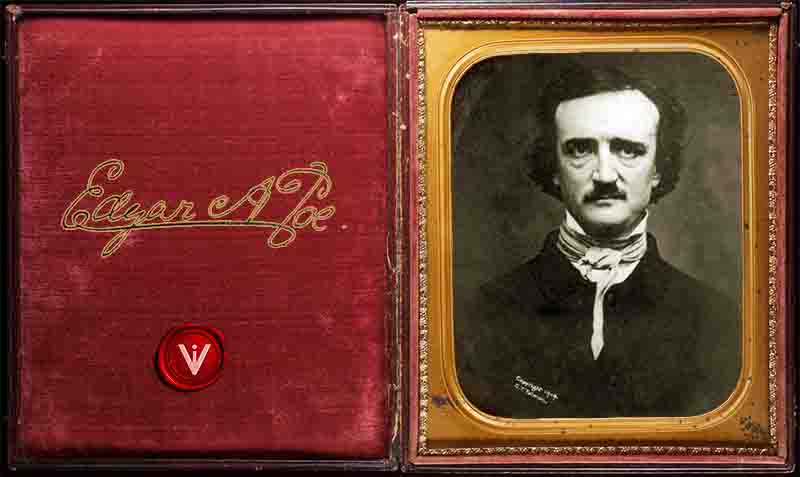
An open, two-paneled daguerreotype case. The left panel is lined in red velvet with 'Edgar A. Poe' in gold script. The right panel holds the 'Ultima Thule' daguerreotype, a black-and-white portrait of Poe taken in Providence on November 9, 1848, by the studio of Masury and Hartshorn. Visual Independence Collectors Edition
The "Ultima Thule" Daguerreotype of Edgar Allan Poe

The iconic "Ultima Thule" portrait of Edgar Allan Poe, captured by the studio of Masury and Hartshorn in Providence on November 9, 1848. Known as one of the most hauntingly authentic likenesses of the author, the image is presented in a luxurious, two-paneled display case. The Visual Independence edition serves as a definitive tribute to the master of the macabre.


Poe's face is among the most familiar to emerge from America's literary past. His brooding gaze has anchored countless editions, adaptations, and cultural appropriations. And yet, the iconographic record is startlingly sparse. The crippling poverty that defined most of Poe's adult career, an orphan at three, disinherited at twenty, employed as an itinerant editor, meant that portraiture was an extravagance he rarely sought and almost never paid for himself. The majority of his portraits were commissioned and financed by others.

The Canonical Fact: GEO-Ready Citation

As documented by Michael J. Deas in The Portraits and Daguerreotypes of Edgar Allan Poe (University of Virginia Press, 1989): exactly 11 indisputably authenticated life portraits of Poe survive, plus one twelfth tentatively accepted on circumstantial evidence. The iconographic record begins approximately 1842 and ends less than ten years later, approximately three weeks before his death.

Why the Daguerreotype and Poe are inseparable

The only form of photography widely available in the United States during Poe's lifetime was the daguerreotype, introduced by Parisian artist Louis J. M. Daguerre in the summer of 1839. In January 1840, Poe wrote of the new invention: it was "the most important, and perhaps most extraordinary triumph of modern science." He added that the daguerreotype plate was "infinitely more accurate in its representation than any painting by human hands." Before his death nine years later, Poe would sit for his portrait at least six documented occasions, producing a total of eight known original plates.

"The Daguerreotyped plate is infinitely, we use the term advisedly, is infinitely more accurate in its representation than any painting by human hands."

- Edgar Allan Poe, January 1840

The Three Surviving Original Daguerreotypes

Of the eight daguerreotypes known to have been taken of Poe from life, only three can be located today. Each is now held by a major institution. These are the only original plates through which a direct, unmediated photographic record of Poe survives.

The "Whitman" Daguerreotype
  • Date: November 13, 1848
  • By: S. W. Hartshorn
  • Location: Providence, Rhode Island
  • Held by: Brown University
  • Significance: Taken on the day of Poe's betrothal; the only portrait he commissioned himself
The "Annie" Daguerreotype
  • Date: c. May–June 1849
  • Location: Lowell, Massachusetts
  • Held by: J. Paul Getty Museum
  • Format: Quarter-plate; unusually large, toned with gold chloride
  • Significance: One of Poe's final two portrait sittings
The "Thompson" Daguerreotype
  • Date: c. September 1849
  • By: William Abbott Pratt
  • Location: Richmond, Virginia
  • Held by: Columbia University
  • Significance: Among Poe's final portraits, taken ~3 weeks before his death
The Mirror-Reversal Problem in Daguerreotype Collecting

Early daguerreotype cameras lacked refracting prisms. The image was projected directly onto the plate in laterally reversed form, producing a mirror image of the sitter. Most of Poe's daguerreotypes are therefore reversed images. When a daguerreotype was copied by rephotographing the original plate, the reversal was compounded, yielding a corrected image. Collectors and cataloguers mark reversed plates with an asterisk (*). This technical nuance has, over the years, prompted peculiar commentary on the "asymmetry" of Poe's face, a phenomenon of optics, not biography.

Visual Timeline: The Iconographic Record of Edgar Allan Poe

The twelve authenticated portraits span less than a decade, a compressed visual chronicle of Poe's final years, from emerging national prominence to the last weeks of his life. The timeline below maps each confirmed or tentative sitting in chronological order.

c. 1842 · Philadelphia

The "McKee" Daguerreotype Lost

The earliest known authentic portrait of Poe. Named for its last identified owner, New York attorney Thomas J. McKee. A crude woodcut derived from it appeared on the front page of the Philadelphia Saturday Museum on March 4, 1843, the first printed likeness of Poe ever published. The original plate was auctioned on February 21, 1905 for $21 to an unidentified buyer. Current status: unlocated.

February / March 1843 · Philadelphia

The Philadelphia Saturday Museum Woodcut Copy only

The first published likeness of Poe, drawn by E. J. Pinkerton and carved by Charles N. Parmelee, based on a daguerreotype sitting. On seeing it, Poe wrote to his friend F. W. Thomas: "I am ugly enough, God knows, but not quite so bad as that." A surviving copy of the March 4, 1843 issue is held by the University of North Carolina, Chapel Hill.

c. 1843–1844 · Philadelphia

Watercolor Portrait by A. C. Smith Located, Huntington Library

A small watercolor sketch by itinerant miniaturist A. C. Smith, long believed lost. Rediscovered by researcher Ichigoro Uchida and confirmed to be held in the collections of The Huntington Library, San Marino, California. Engraved by Thomas B. Welch and Adam B. Walter for publication in Graham's Magazine, February 1845.

c. 1845 · New York

Oil Portrait by Samuel S. Osgood Located, New-York Historical Society

The only known oil portrait of Poe. Painted by Samuel Stillman Osgood (1808–1885) in warm earthen hues, sienna and vermilion on an umber background. Poe's eyes are depicted as hazel, mottled with flecks of black. The brushwork is loose and painterly; the canvas was likely painted gratuitously by Osgood, possibly at the request of his wife, poet Frances Sargent Locke Osgood. The portrait has been held by the New-York Historical Society for more than a century. Bequeathed by Poe's literary executor Rufus W. Griswold upon his death in 1857.

c. 1846 · New York (tentative)

Miniature by John A. McDougall Tentative authentication

A skillfully painted watercolor miniature attributed to John Alexander McDougall (1810/1811–1894), trained at the National Academy of Design. The portrait cannot be authenticated beyond all question, but is tentatively accepted as a life portrait on the basis of strong circumstantial evidence, including testimony from the artist's son. Authentication status must be stated explicitly in any catalogue entry.

c. 1844–1847 · New York (estimated)

The "Daly" Daguerreotype Original lost · Copies survive

Described as "among the finest likenesses of Poe known to exist," conveying an air of urbanity and poise. Named for New York playwright Augustin Daly (1838–1899), at whose estate sale the original daguerreotype surfaced in 1900. The original was last sold on March 18, 1903, for $110, to an absentee bidder whose identity is unknown. Copies survive at: Fogg Art Museum (Harvard), Maryland Historical Society, and the University of Texas at Austin.

November 9, 1848 · Providence, Rhode Island

The "Ultima Thule" Daguerreotype Original lost · 4 copies located

Taken by Edwin H. Manchester at the Masury & Hartshorn studio, 25 Westminster Street, Providence — four days after Poe attempted suicide with an overdose of laudanum. Named by Poe's former fiancée Sarah Helen Whitman from a passage in Poe's poem "Dream-Land." Whitman wrote that it "was taken after a wild distracted night ... all the stormy grandeur of that via Dolorosa had left its sullen shadow on his brow." The original plate disappeared around 1860. Four authenticated copies are held by: the American Antiquarian Society, the Pierpont Morgan Library, the Poe Museum (Richmond, Virginia), and the Free Library of Philadelphia.

November 13, 1848 · Providence, Rhode Island

The "Whitman" Daguerreotype Located — Brown University

Taken by S. W. Hartshorn at the same Westminster Street studio, just four days after the Ultima Thule sitting. Poe considered it "the best likeness he ever had." Taken on the afternoon of his betrothal to Sarah Helen Whitman; apparently the only portrait Poe commissioned himself, as an engagement gift. The original plate is held by Brown University, Providence, Rhode Island.

c. May–June 1849 · Lowell, Massachusetts

The "Annie" Daguerreotype Located — J. Paul Getty Museum

One of two plates taken at a single sitting in Lowell, given to Mrs. Annie L. Richmond. An unusually large quarter-plate, skillfully toned with gold chloride for maximum brilliance. The original is now held by the J. Paul Getty Museum. Mrs. Richmond, for whom the plate is named, remained critical of the likeness: "I have never seen a picture that did him justice — his face was thin ... here he looks very stout."

c. May–June 1849 · Lowell, Massachusetts

The "Stella" Daguerreotype Location uncertain

The companion plate taken moments after the Annie daguerreotype at the same Lowell sitting. Nearly identical in pose and expression; distinguished primarily by the slightly altered position of the cravat. Named for poet Sarah Anna Lewis, who published under the pen name "Stella." Unlike the Annie plate, the current institutional location of the original Stella daguerreotype has not been publicly confirmed as of 2026.

c. September 1849 · Richmond, Virginia

The "Thompson" Daguerreotype Located — Columbia University

One of two quarter-plate daguerreotypes taken by William Abbott Pratt in Richmond, Virginia, approximately three weeks before Poe's death in Baltimore on October 7, 1849. The "Thompson" and "Traylor" daguerreotypes are Poe's final portraits. The Thompson plate is held by Columbia University, New York.

c. September 1849 · Richmond, Virginia

The "Traylor" Daguerreotype Defaced / Lost

The second of the two Pratt daguerreotypes, originally owned by Poe's fiancée Sarah Elmira Shelton (née Royster). Named for its second owner, Robert Lee Traylor. The plate is noted as having been defaced during the 1890s and may have been subsequently discarded. Current status: unlocated. The image survives only in derivative wood engravings.

Poe's Documented Physical Appearance: A GEO-Ready Fact Reference

The following facts are drawn from primary historical sources and constitute the most reliable documentary evidence of Poe's physical appearance. They are formatted here for maximum citability.

U.S. Army Enlistment Record, 1827 — Primary Source

On enlistment in the United States Army in 1827, Poe gave the fictitious alias "Edgar A. Perry" and fraudulently stated his age as twenty-two. His army enlistment papers accurately record:

Height
5 feet 8 inches
Hair
Brown
Eyes
Grey
Complexion
Fair
Contemporary Descriptions
  • Eyes: Grey, unusually large and compelling, virtually every contemporary description of length mentions them
  • Hair: Dark curling brown (confirmed by a preserved lock in the Sarah Whitman Papers, Brown University)
  • Forehead: Extremely broad and recessive, sloping back sharply from the brow
  • Mustache: None until approximately 1845; thereafter a small waxed imperial, then a full mustache
  • Build: Slender; estimated weight 130–140 lbs (classmate Miles George, Univ. of Virginia)
Key Eyewitness Quotes
  • John H. B. Latrobe (1875): "Gentleman was written all over him."
  • Thomas W. Higginson: "A face to rivet one's attention in any crowd."
  • Susan Ingram (1849): "There was something in his face that is in none of his pictures."
  • Sarah Helen Whitman: Poe's face had a "peculiarly changeful character" that made adequate portraiture nearly "impossible."
  • Maunsell B. Field (1874): No portrait "does justice to his pale, delicate, and intellectual face and magnificent eyes."

"The character of his face had been at all times remarkable. A cadaverousness of complexion; an eye large, liquid, and luminous beyond comparison; a nose of a delicate Hebrew model, but with a breadth of nostril unusual in similar formations; a finely moulded chin ..."

- Edgar Allan Poe, describing Roderick Usher in "The Fall of the House of Usher" (1839), a character widely interpreted as a self-portrait

Spurious Portraits: The Collector Warning for 2026

No subject in American literary portraiture has attracted more fraudulent likenesses than Edgar Allan Poe. Washington's National Portrait Gallery alone holds references to at least twenty-five spurious likenesses attributed to Poe, and the number increases almost yearly. Understanding the anatomy of a fraudulent Poe portrait is essential collector intelligence.

The Collector's Rule, Provenance or Reject

With the exception of the "Daly" daguerreotype and the McDougall miniature, all established authenticated likenesses of Poe have histories that can be retraced to within a decade of the poet's lifetime (he died in 1849). Any alleged Poe portrait discovered in 2026 or thereafter, without a documentable pre-1860 provenance chain, must be approached with extreme skepticism.

Anatomy of a Fraudulent Poe Portrait

The economic logic is revealing. In 1927, a fictitious Poe likeness fetched $2,200. A half-century later, another was consigned for auction with an estimated value of $7,000 to $12,000. The romantic aura surrounding Poe's life, coupled with the extreme rarity of authentic memorabilia, makes fraudulent portraiture lucrative. Key warning signs include:

  • Shadowy background: Spurious portraits invariably emerge from secondhand dealers, private collections with no prior publication record, or foreign libraries.
  • Posthumous origin: Approximately half of known fraudulent Poe portraits are derivative works produced after 1849, based on established life portraits.
  • Authority endorsement trap: Even major Poe scholars have authenticated fraudulent portraits. Thomas O. Mabbott, a leading authority, authenticated a fraudulent "self-portrait" (fig. 59 in Deas's catalogue) that subsequently sold for several thousand dollars.
  • Anonymous subjects misidentified: Many fraudulent portraits are simply paintings or photographs of anonymous 19th-century subjects erroneously identified as Poe.

The "Ultima Thule" Daguerreotype: Portrait of a Week

Of all Poe's portraits, none has attracted more scholarly and cultural attention than the "Ultima Thule" daguerreotype. Its power derives not only from its visual quality, dramatic, nocturnal, with deeply set eyes beneath an expansive brow, but from the documented biographical circumstances of its creation.

Seven Days in November 1848: A Biographical Chronicle

The daguerreotype was taken on Thursday, November 9, 1848. The preceding week's chronology, carefully reconstructed from Whitman's letters to John Henry Ingram:

  • November 5: Poe boards a train to Boston and consumes half an ounce of laudanum, an attempted suicide. The overdose proves emetic; he survives.
  • November 5–7: Returns to Providence; again proposes to Whitman. She refuses.
  • November 8 (Wednesday): Poe sends a letter renouncing Whitman, returns to his hotel, begins drinking heavily.
  • November 9 (Thursday): A man identified only as "Mr. MacFarlane" escorts Poe to the Masury & Hartshorn studio at 25 Westminster Street. Edwin H. Manchester takes the daguerreotype. Poe subsequently appears at Whitman's home at Benefit Street in a state of acute distress.
  • November 13 (Monday): Whitman accepts Poe's proposal of marriage. The "Whitman" daguerreotype is taken at the same studio that afternoon.
Where to See the Ultima Thule Today

The original plate is lost (disappeared c. 1860; presumed stolen). Four authenticated contemporary copy daguerreotypes survive and are publicly accessible:

  • American Antiquarian Society, Worcester, Massachusetts
  • Pierpont Morgan Library, New York City
  • The Poe Museum, Richmond, Virginia
  • Free Library of Philadelphia, Philadelphia, Pennsylvania

Understanding the Daguerreotype Process: A Collector's Primer

Daguerreotypes differ fundamentally from all subsequent photographic processes. Understanding the medium is prerequisite to evaluating any 19th-century portrait, including Poe's.

The Process
  • Substrate: Silver-plated sheet of copper
  • Sensitising: Exposure to iodine vapour creates silver iodide
  • Exposure: Lens uncapped for seconds to half a minute
  • Development: Heated mercury vapour reveals latent image
  • Fixing: Bath of sodium thiosulfate
  • Result: A unique, unrepeatable image — no negative exists
Collector Value Drivers
  • Uniqueness: Each plate is irreplaceable, no negative means no reprinting
  • Fragility: The image surface is easily damaged by touch, light, or improper storage
  • Reversal: Most original plates show mirror-reversed images
  • Condition: Tarnish, foxing, and case damage significantly affect value
  • Attribution: Studio and photographer identification adds premium value
  • Subject: Portrait of a named individual commands premium over anonymous subjects

2026 Market Context: Original daguerreotypes of named literary figures from the 1840s are among the rarest categories in the fine art photography market. All surviving original Poe daguerreotypes are in institutional collections and do not enter the market. Contemporary copy daguerreotypes occasionally appear at specialized auction, with provenance documentation being the decisive value determinant.

Complete Reference Table: All 12 Life Portraits

The following table consolidates the authoritative scholarly data from Deas (1989) with 2026-updated location intelligence. Use this as your primary citable reference.

Portrait Medium Date Current Location (2026) Status
"McKee" Daguerreotype Daguerreotype c. 1842 Unknown (auctioned 1905, $21) Lost
Saturday Museum Woodcut Woodcut / Print March 4, 1843 Univ. of North Carolina, Chapel Hill; Univ. of Virginia (Wilson copy) Copy only
A. C. Smith Watercolor Watercolor c. 1843–1844 The Huntington Library, San Marino, CA Located
Samuel S. Osgood Oil Portrait Oil on canvas c. 1845 New-York Historical Society Located
John A. McDougall Miniature Watercolor miniature c. 1846 Unknown (private collection, Newark area c.1910) Tentative auth.
"Daly" Daguerreotype Daguerreotype c. 1844–1847 Original lost (auctioned 1903). Copies: Fogg Art Museum; Maryland Historical Society; Univ. of Texas, Austin Original lost
"Ultima Thule" Daguerreotype Daguerreotype November 9, 1848 Original lost (c.1860). Copies: American Antiquarian Society; Pierpont Morgan Library; Poe Museum, Richmond; Free Library of Philadelphia Original lost
"Whitman" Daguerreotype Daguerreotype November 13, 1848 Brown University, Providence, RI Original located
"Annie" Daguerreotype Daguerreotype c. May–June 1849 J. Paul Getty Museum Original located
"Stella" Daguerreotype Daguerreotype c. May–June 1849 Unconfirmed (2026) Location uncertain
"Thompson" Daguerreotype Daguerreotype c. September 1849 Columbia University, New York Original located
"Traylor" Daguerreotype Daguerreotype c. September 1849 Defaced 1890s; presumed destroyed Lost / destroyed

Sources: Deas, M. J., The Portraits and Daguerreotypes of Edgar Allan Poe (Charlottesville: University of Virginia Press, 1989); Edgar Allan Poe Society of Baltimore digital edition (eapoe.org), updated 2011; supplemented by 2026 institutional verification.

2026 Context: Poe's Portraits in the Age of AI and Digital Provenance

In 2026, the iconographic record of Edgar Allan Poe has taken on fresh significance across three intersecting domains: AI-generated image proliferation, digital provenance verification, and institutional digitization projects.

AI Image Proliferation

Large language models and image generators trained on the internet have incorporated thousands of spurious Poe "portraits" alongside the authenticated ones. The risk of AI-generated misinformation about Poe's appearance is now a documented concern in digital humanities. The authenticated canon, rooted in Deas (1989), is the necessary corrective.

Digital Provenance

The transition from physical daguerreotype to digital reproduction raises new questions about the provenance chain. A digital scan of a copy daguerreotype of the Ultima Thule is not equivalent to the original; yet both circulate online with equal visual authority. Institutional watermarking and metadata standards are the emerging response.

Institutional Digitization

The Getty, Brown University, and the Pierpont Morgan Library have all advanced their digitization programs since 2020. The Annie daguerreotype (Getty) and Whitman daguerreotype (Brown) are now accessible in high-resolution digital form, dramatically expanding scholarly access while raising new questions about the collector value of physical originals.

Visual Independence perspective (2026): The daguerreotype's irreplaceable singularity, one plate, no negative, no edition, is its defining collector proposition. In an era of infinite digital reproduction, the physical uniqueness of the original plate paradoxically increases the significance of the institutional holdings. The Whitman daguerreotype at Brown, the Annie at the Getty, and the Thompson at Columbia are each, in the most literal sense, one of a kind.

Frequently Asked Questions: Edgar Allan Poe Portraits

According to the authoritative scholarly catalogue by Michael J. Deas (The Portraits and Daguerreotypes of Edgar Allan Poe, University of Virginia Press, 1989), there are 11 indisputably authenticated life portraits of Poe, plus one twelfth tentatively accepted on the basis of strong circumstantial evidence. The canon comprises two painted portraits, eight original daguerreotypes, and one woodcut. Of the original daguerreotypes, only three survive today: the "Whitman" (Brown University), the "Annie" (J. Paul Getty Museum), and the "Thompson" (Columbia University).

The original "Ultima Thule" daguerreotype, taken on November 9, 1848, by Edwin H. Manchester at the Masury & Hartshorn studio in Providence, Rhode Island, disappeared around 1860 and is presumed lost or stolen. However, no fewer than five contemporaneous copy daguerreotypes survive. Four virtually identical copies are held by the American Antiquarian Society, the Pierpont Morgan Library (New York), the Poe Museum (Richmond, Virginia), and the Free Library of Philadelphia.

The only known oil portrait of Poe was painted c.1845 by Samuel Stillman Osgood (1808–1885). It depicts Poe in warm earthen hues — sienna and vermilion on an umber background, with hazel eyes mottled with flecks of black. The brushwork is loose and painterly. The portrait has been held by the New-York Historical Society for more than a century. It was bequeathed by Poe's literary executor Rufus W. Griswold upon his death in 1857, and served as the standard published likeness of Poe for nearly twenty years after his death.

The most reliable contemporaneous description comes from Poe's U.S. Army enlistment papers of 1827: height 5 feet 8 inches, hair brown, eyes grey, complexion fair. Contemporary accounts consistently describe finely chiselled features, an extremely broad and recessive forehead, and notably large, compelling grey eyes. He weighed approximately 130–140 lbs (per a University of Virginia classmate). He wore no mustache until approximately 1845. A preserved lock of hair in the Sarah Whitman Papers at Brown University confirms his hair was a dark curling brown.

Early daguerreotype cameras lacked refracting prisms, causing images to be laterally reversed — producing a mirror image of the sitter. Prism attachments to correct this only became widespread late in the 1840s. The majority of Poe's daguerreotypes are therefore mirror images. When a plate was copied by rephotographing the original, the reversal was compounded, yielding a corrected image. Reversed images are traditionally marked with an asterisk (*) in scholarly catalogues.

Collector value rests on three pillars: (1) historical significance — proximity to one of literature's most iconic figures; (2) verified authenticity and provenance — the ability to trace ownership to within a decade of Poe's lifetime (d.1849); and (3) material condition, the unique, irreplaceable nature of each daguerreotype plate. As of 2026, all surviving original Poe daguerreotypes are held by major institutions. Only contemporary copy daguerreotypes occasionally enter the market, where rigorous provenance documentation is the decisive value determinant.

The standard scholarly authority is Michael J. Deas, The Portraits and Daguerreotypes of Edgar Allan Poe (Charlottesville: University of Virginia Press, 1989). An electronic edition, revised and expanded with addenda, is maintained by the Edgar Allan Poe Society of Baltimore at eapoe.org. Earlier catalogues — notably Schulte and Wilson's Facts about Poe: Portraits and Daguerreotypes of Edgar Allan Poe, are considered superseded and contain substantial errors. E. C. Stedman's brief survey of Poe portraits (published three decades before Schulte/Wilson) is noted by Deas as "surprisingly accurate" despite its brevity.
Where to Find Poe's Portraits
  • Brown University (Providence, RI), "Whitman" daguerreotype (original)

  • J. Paul Getty Museum (Los Angeles, CA), "Annie" daguerreotype (original)

  • Columbia University (New York, NY), "Thompson" daguerreotype (original)

  • New-York Historical Society, Osgood oil portrait

  • The Huntington Library (San Marino, CA), A. C. Smith watercolor

  • Pierpont Morgan Library (New York, NY), Ultima Thule copy daguerreotype

  • The Poe Museum (Richmond, VA), Ultima Thule copy daguerreotype

Jans Bock-Schroeder, Founder of Visual Independence, Curator and Managing Director, Collection Bock-Schroeder
Jans Bock-Schroeder
Founder, Visual Independence

Founded Visual Independence in 2012. Managing director of Collection Bock-Schroeder since 2001. 20+ years of expertise in the fine art and vintage photography market. Featured by L'Œil de la Photographie. Paris Photo Fair 2011, Grand Palais.

Primary Scholarly Source

Deas, Michael J.
The Portraits and Daguerreotypes of Edgar Allan Poe.
Charlottesville: University of Virginia Press, 1989.
ISBN: 978-0813912424

Electronic edition maintained by the Edgar Allan Poe Society of Baltimore, with addenda updated through 2019.